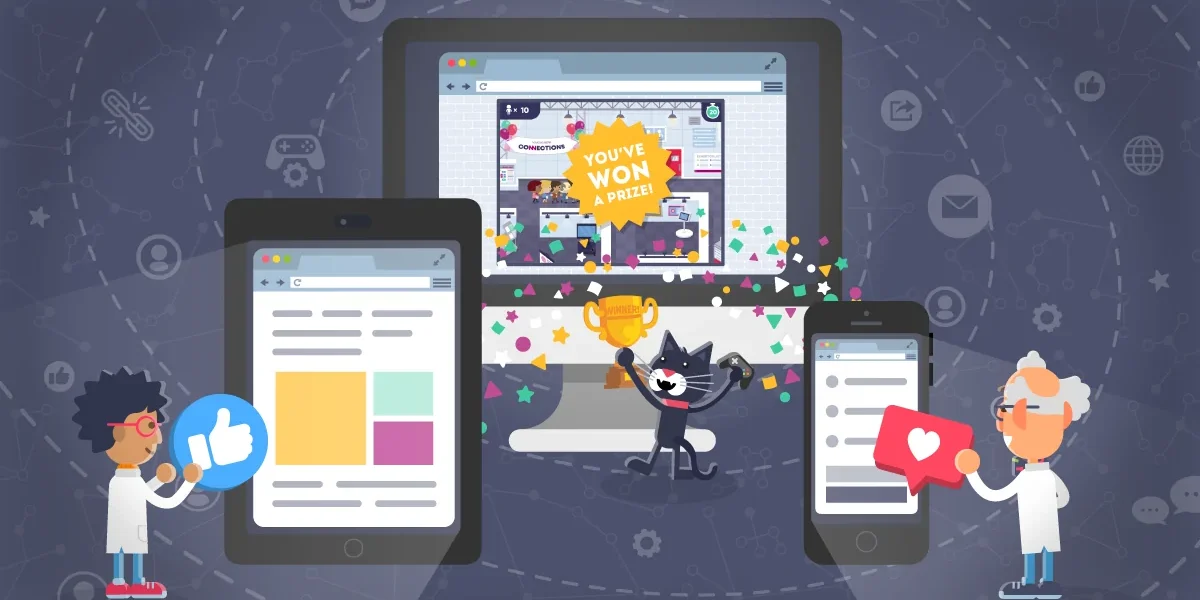

Let’s be honest for a second. You’ve probably scrolled past a thousand static blog posts today alone. Your audience does the same. They’re tired of reading walls of text, tired of passive scrolling, and honestly? They’re bored. That’s where interactive content marketing steps in — not as a buzzword, but as a genuine shift in how brands talk with people, not at them.
Think of it this way: traditional content is a lecture. Interactive content is a conversation. And in a world where attention spans are shorter than a goldfish’s memory (literally, about 8 seconds), a conversation beats a lecture every single time. Here’s the deal — immersive brand experiences aren’t just about flashy tech or VR headsets. They’re about making your audience feel something, do something, and remember you because of it.
What Exactly Is Interactive Content Marketing?
Interactive content is any piece of media that requires active engagement from the user. Not just clicking “next page” — I mean real participation. Quizzes, polls, calculators, interactive infographics, 360-degree videos, augmented reality try-ons, even simple sliders that change a product’s color. The user’s input shapes their experience. That’s the core difference.
And here’s the kicker: it works. According to a study by Demand Gen Report, 91% of buyers say they prefer interactive and visual content over traditional, static formats. Ninety-one percent. That’s not a rounding error. That’s a mandate.
Why Immersion Matters More Than Information
Information tells. Immersion sells. When someone takes a quiz titled “What’s Your Design Aesthetic?” they’re not just learning about themselves — they’re investing time and emotional energy into your brand. That investment creates a psychological anchor. It’s like the IKEA effect, but for content. People value what they help create.
I remember working with a skincare brand that had a static FAQ page. Traffic was fine, but conversions were flat. We swapped one section for an interactive “Skin Type Diagnostic” tool. Users answered five quick questions, got a personalized routine, and — boom — time on page tripled. More importantly, add-to-cart rates jumped by 34%. Not because the product changed. Because the experience changed.
The Building Blocks of an Immersive Experience
You don’t need a six-figure budget to create immersion. You need intention. Here are the core elements that make interactive content feel less like a gimmick and more like a memory:
- Personalization at the core: The user should see themselves in the outcome. Whether it’s a quiz result, a calculator output, or a configurator, the result must feel uniquely theirs.
- Immediate feedback loops: No one likes waiting. Interactive content should respond instantly. A progress bar, a visual change, a score updating — these micro-interactions keep the brain engaged.
- Low friction, high reward: Keep the barrier to entry low. Don’t ask for an email upfront. Let them play first. Ask for the email after they’ve seen value. That’s when they’re most willing to trade contact info.
- Sensory richness: Even without VR, you can create depth. Use color psychology, sound cues (if appropriate), and motion design that feels tactile. Think of it as staging a small theater piece — every element should serve the story.
Now, let’s get practical. What does this look like in the wild? And how do you choose the right format for your goals?
Types of Interactive Content That Actually Drive Results
Not all interactivity is created equal. Some formats are great for awareness, others for conversion, and a few for loyalty. Here’s a quick breakdown of the heavy hitters:
| Format | Best For | Example Use Case |
|---|---|---|
| Quizzes & Assessments | Lead generation, segmentation | A financial brand offering a “Retirement Readiness Score” |
| Interactive Calculators | High-intent conversion | A home improvement store’s “Paint Cost Estimator” |
| Polls & Surveys | Community building, data collection | A coffee brand asking “Which roast matches your morning mood?” |
| Interactive Infographics | Education, brand authority | A health org visualizing the impact of sleep on productivity |
| AR Try-On / Configurators | E-commerce, product personalization | A eyewear brand letting users “try on” glasses via webcam |
| Interactive Videos | Storytelling, deep engagement | A travel company’s “Choose Your Own Adventure” destination video |
See the pattern? Each format turns a passive reader into an active participant. And participation, even small, builds a bridge between curiosity and commitment.
The Psychology Behind the Magic
Why does this work on a neurological level? It’s about the endowment effect — we overvalue things we feel ownership over. When someone clicks, drags, or chooses, they’re literally building the experience. Their brain says, “I made this.” That ownership feeling transfers to your brand. It’s subtle, but it’s powerful.
There’s also the curiosity gap. Interactive content often starts with a question. And unanswered questions create tension in the brain — a small itch that demands scratching. You’re not just giving information; you’re offering relief. That’s why quizzes are so addictive. The payoff isn’t just the answer — it’s the release of cognitive tension.
Weaving Interactive Elements Into Your Existing Strategy
You don’t need to rebuild your entire content engine. Start small. Embed a poll in your next blog post. Add a slider to compare before/after images. Turn your most popular FAQ into a simple branching quiz. The goal is to test, learn, and iterate.
One mistake I see constantly? Brands treat interactive content as a one-off campaign. That’s like planting a tree and never watering it again. The real ROI comes from reusing and updating your interactive assets. A quiz from 2022 can be refreshed with new questions in 2024. A calculator can be expanded with new variables. This not only saves resources but also signals to search engines that your page is fresh.
SEO and Interactive Content: A Love Story
Here’s where things get interesting for search visibility. Interactive content tends to earn more backlinks naturally — because it’s link-worthy. People share tools, not pages. A great calculator or a fun quiz gets embedded in blog posts, mentioned in newsletters, and shared on social. That’s organic authority, which is gold for SEO.
Also, dwell time — the amount of time a visitor stays on your page — is a ranking factor (indirectly, but still). Interactive content keeps people on the page longer. They’re not bouncing after 10 seconds. They’re clicking, typing, exploring. That sends positive signals to Google’s algorithms. Plus, you’re solving a real problem, which is what E-E-A-T (Experience, Expertise, Authoritativeness, Trustworthiness) is all about.
But a word of caution: don’t stuff keywords into your interactive tool. The experience should feel natural. Use descriptive alt text for visual elements, write a clear meta description, and ensure your interactive element is accessible (keyboard navigable, screen-reader friendly). Accessibility isn’t just ethical — it’s good SEO practice.
Common Pitfalls (And How to Dodge Them)
Not everything that glitters is gold. Interactive content can flop if you’re not careful. Here are the biggest traps I’ve seen:
- Overcomplicating the UX: If a user needs a manual to use your tool, you’ve lost. Keep the interface dead simple. One question at a time. Big buttons. No jargon.
- Gating everything: Don’t put a form in front of every interaction. Let your audience taste the value first. Gate the results, not the experience.
- Ignoring mobile: Over 60% of web traffic is mobile. If your interactive element requires hover states or precise dragging, you’re alienating most of your audience. Design for thumbs, not mice.
- Forgetting the “so what”: The interaction must lead to a meaningful outcome. If a quiz doesn’t give a useful result, it’s just a gimmick. Always connect the output to a next step — a product recommendation, a content suggestion, or a personalized tip.
Another thing — don’t force interactivity where it doesn’t belong. A legal disclaimer doesn’t need to be a game. A white paper doesn’t need a spinning wheel. Match the format to the intent. Sometimes, a well-written, static article is still the best tool. Interactive content is a spice, not the whole meal.
Measuring What Matters
So how do you know if it’s working? Vanity metrics like “time on page” are nice, but dig deeper. Look at completion rates — what percentage of users finish your quiz or calculator? Look at share rates — are people posting their results on social? And most importantly, look at conversion lift — are users who interact more likely to buy, subscribe, or inquire?
Set up event tracking in Google Analytics. Tag the final click of your interactive element as a conversion. Then compare that cohort against users who didn’t interact. You’ll often see a 2x to 3x difference in engagement metrics. That’s your proof.
And don’t forget qualitative feedback. Ask a few users what they thought. Their words will guide your next iteration better than any dashboard.
The Future Is Participatory
We’re moving toward a web that’s less about reading and more about doing. Voice interfaces, AR filters, real-time personalization — the trend is clear. Brands that treat content as a one-way broadcast will fade. Brands that invite participation will thrive.
But here’s the thing — you don’t need to wait for the future. You can start today. A simple poll on your homepage. A personality quiz in your next campaign. An interactive map for your local business. The tools are accessible, the ROI is measurable, and the audience is waiting.